


ok, so as you are on the journey of becoming, apparently it’s a best practice to share what you’re learning out loud. it’s called a building in public log that memorializes milestones, learnings, insights, new discoveries, failures and all the things.
we are now in an era that we call the trust economy. because we’ve been lied to everywhere – at work, by the government, technology, friends, relationships, etc… – people don’t trust each other. so as you’re building towards something, radical honesty and transparency become your most valuable currency to build relationships with those you are meant to serve.
for those that are new or maybe don’t remember, i made a commitment 12 weeks ago to be in consistent practice of writing the truth of my work story. this began June 22, 2026, with this essay…

long story short, we (Kevin Stuckey and i) are on a journey to live and work according to God’s design. so far, following the world’s way of work and life has led to burnout, chronic disappointment and un-fulfillment. so we gave up the world’s way and left corporate in 2022 to follow God with our whole heart and whole life. we sold everything, downsized our lives and started to ask vigorously, what are our lives an answer to?
over the last four years, we’ve discovered that we are here to help change the culture of work. which means telling the truth about the current state of work, helping more people recover from their workplace trauma, helping them understand what their real work is and helping them get into expression by focusing on the practices (not outcomes) that will get them there.
one of the things i’ve discovered on this journey is that i’m a writer and a storyteller. hence, i’m the current narrator of ftl. i finally claimed my new found identity and Substack has become our “gym,” a space to practice radical honesty, build my creative endurance, and rawly process my journey in public every six weeks or so.
the last update was July 21…

here’s what’s happened since then…
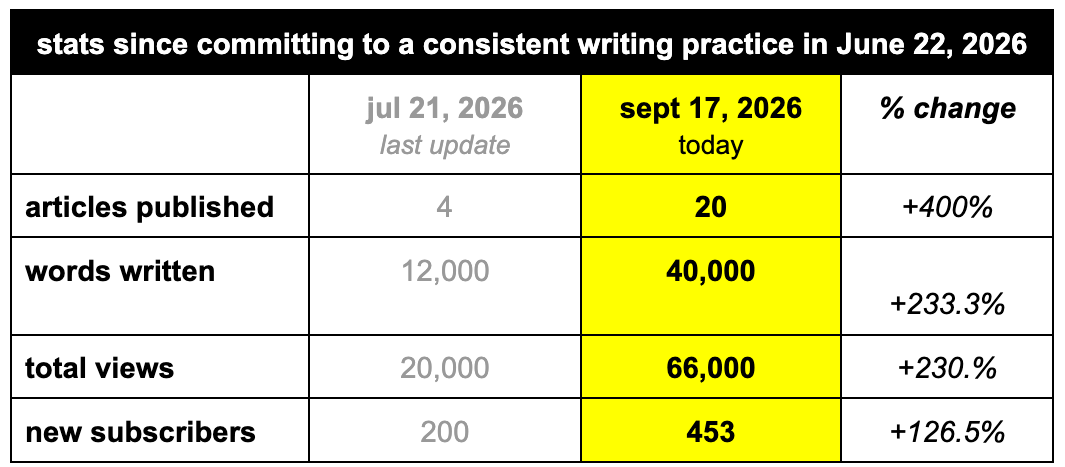
latest stats and milestones
the only focus to date has been to be consistent in writing. and i’m happy to say we’ve done that! i tend to be someone who has big vision and because of that vision i do too much too soon. so i’ve had to really restrain myself to not worry about distribution, or metrics or even care if the writing is good yet. what started as a once a week practice has increased to writing twice a week. we’ve stayed consistent despite traveling, visitors and all the distractions.
and a reminder, we’re not optimizing for growth, we’re optimizing for consistency of practice.
what we’re learning about substack
substack continues to be one of the more interesting platforms i’ve played on. we like substack because there’s a great return on your investment here. good writing is good thinking. so being in practice of writing grows you while you grow your audience. plus, you get to own your audience through subscribers that you can reach directly. and there’s built in discovery to grow on the platform with the 35m+ people who are active here.
1. 70% of our subscriber growth comes from notes. substack is like a neighborhood. notes is like being outside of your house and hanging out with your neighbors having casual conversations. and articles are like the unique interior design of your home. people meet you outside first and then come take a peek at your house to see if they want to stay awhile. don’t expect massive subscriber growth off of your articles. i think this will change when we really start thinking about external distribution, but we’re not there yet.
2. there’s a massive delayed gratification and response to content here. when you post something on other platforms, you will know within the first 10 min or hour whether or not it has “heat” and will travel. on Substack, there are notes i’ve posted that have taken off 5 days later, 10 days later or 15 days later. this is really important to understand because you can’t get discouraged if you don’t see engagement right away because we’ve been conditioned on other platforms to know if something “worked” immediately. here, it’s really interesting to think about what you want to say and then let it go. it changes your orientation with content to not perform for other people’s response, but to really just explore your own thoughts and creativity. i think it’s a really good thing.
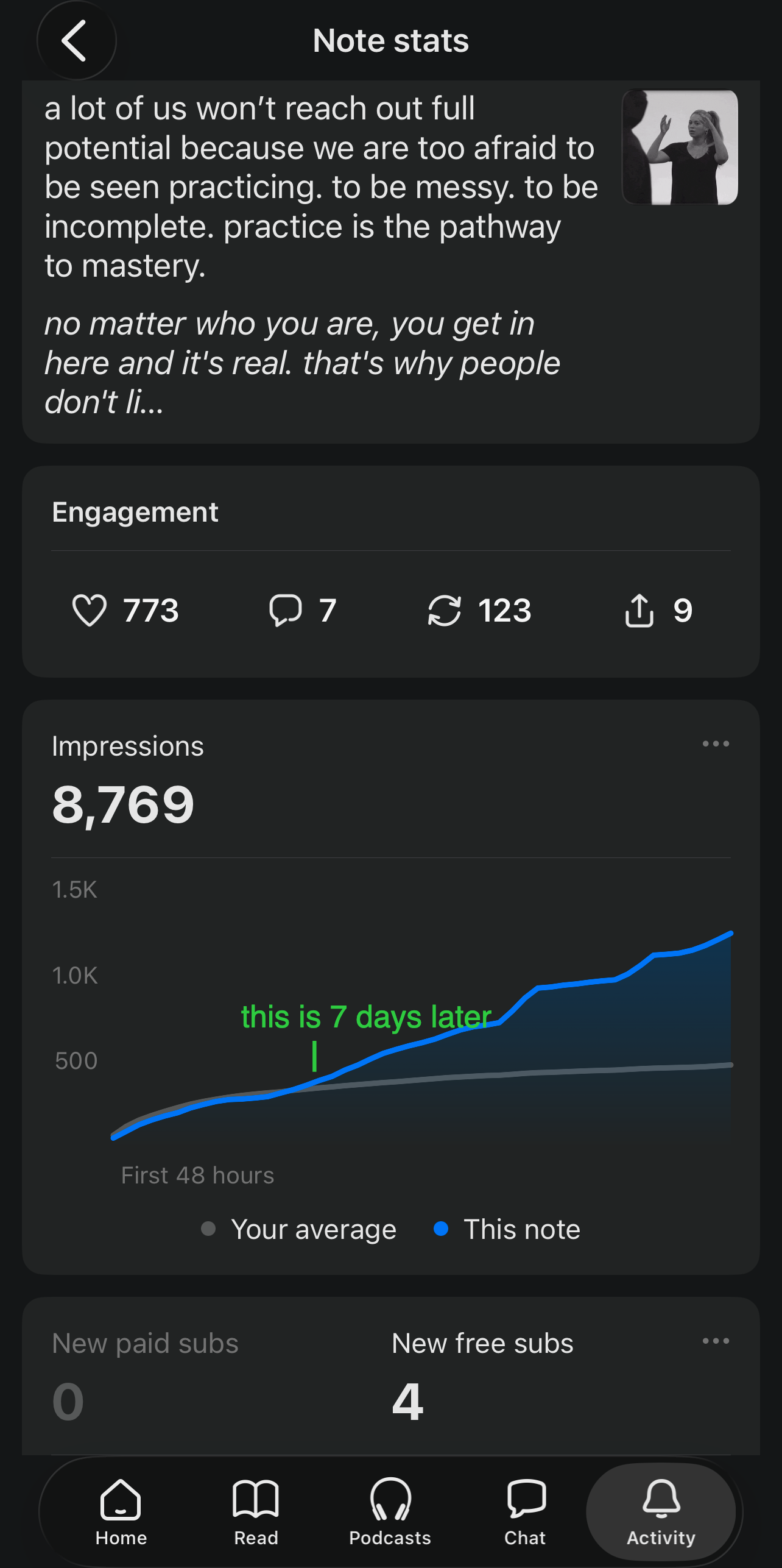
3. many people will come and go on substack. i can feel the waves of energy on the platform. substack is not a passive platform like the others. to do well here, you’ve got to really know where you’re going, what you’re in practice of and the thing you could talk about forever essentially. for us, that’s work and workplace stories. so there are an infinite amount of ways to keep exploring. but committing to a long-form platform requires discipline and investment that most aren’t willing to make. so keep going because the difference between you being successful or not is your consistency. that’s really it.
what we’re learning about the practice of writing
i’m so grateful that i focused on the practice and not what you all think about the writing because i would have stopped by now if that was the case. 12 weeks ago i didn’t have a consistent writing practice. now i’m writing about 5000 words a week.
4. the high is gone. the newness has fallen off and it feels like a memorialized discipline now. it doesn’t feel as hard anymore. it’s still torturous in the way writing is. but after writing so many truths about myself outloud, i feel myself becoming more brave and courageous in the creative process. i also find myself being way more honest in all conversations in my life. but there’s an empty void that happens after you release and birth something true about yourself. which is why you cannot be attached to the outcome. that’s not what you’re measuring yourself against. the only measurement that matters is, did you do it? and did you tell the truth?
5. writing more is causing me to want to study writers and storytellers. in addition to reading books i’m genuinely interested in, i’m currently reading books by Maya Angelou, Stephen King and Joan Didion. in the last month or so i’ve watched docs on Toni Morrison, Dan Rather, Mike Wallace, Andre Leon Talley and The New Yorker. I’m fascinated by people’s approach to storytelling.
6. writing has reminded me that i wanted to be a journalist when i was younger. in high school, i said that i wanted to be the EIC of a magazine and own a production company one day. i was managing editor of the high school newspaper and i went to a journalism program at Northwestern when i was 16. it was so intense that i decided i didn’t want to do it anymore. and i wonder if that was just fear or a bad experience. regardless, there’s a childlike joy that comes from learning this space that feels nice.
unexpected things the practice has produced
7. we started a conversation club here on ftl. this was not planned at all. but after obsessing over how crazy Careless People was, we asked if anyone else was down to join. we now have a group chat of 25 ftl’ers who are reading together and preparing for a live virtual meetup later this month. it’s been so fun to get to know people on a deeper level. it made us think, what could happen if we did this monthly? we’re already eyeing the conversation content and topic for October. more to come there.


8. stories matter more than coverage. as part of experimentation, we started playing around with roundups and covering the news around the culture of work. turns out if you’re not breaking news or saying something that other people haven’t said, it doesn’t matter. it’s also not what you all are responding to. the true stories about work are what matter, build engagement (literally 10x more) and help people feel the most seen. so we’re probably going to stick to the personal / cultural essays as the main focus while allowing for more room to experiment with other formats.
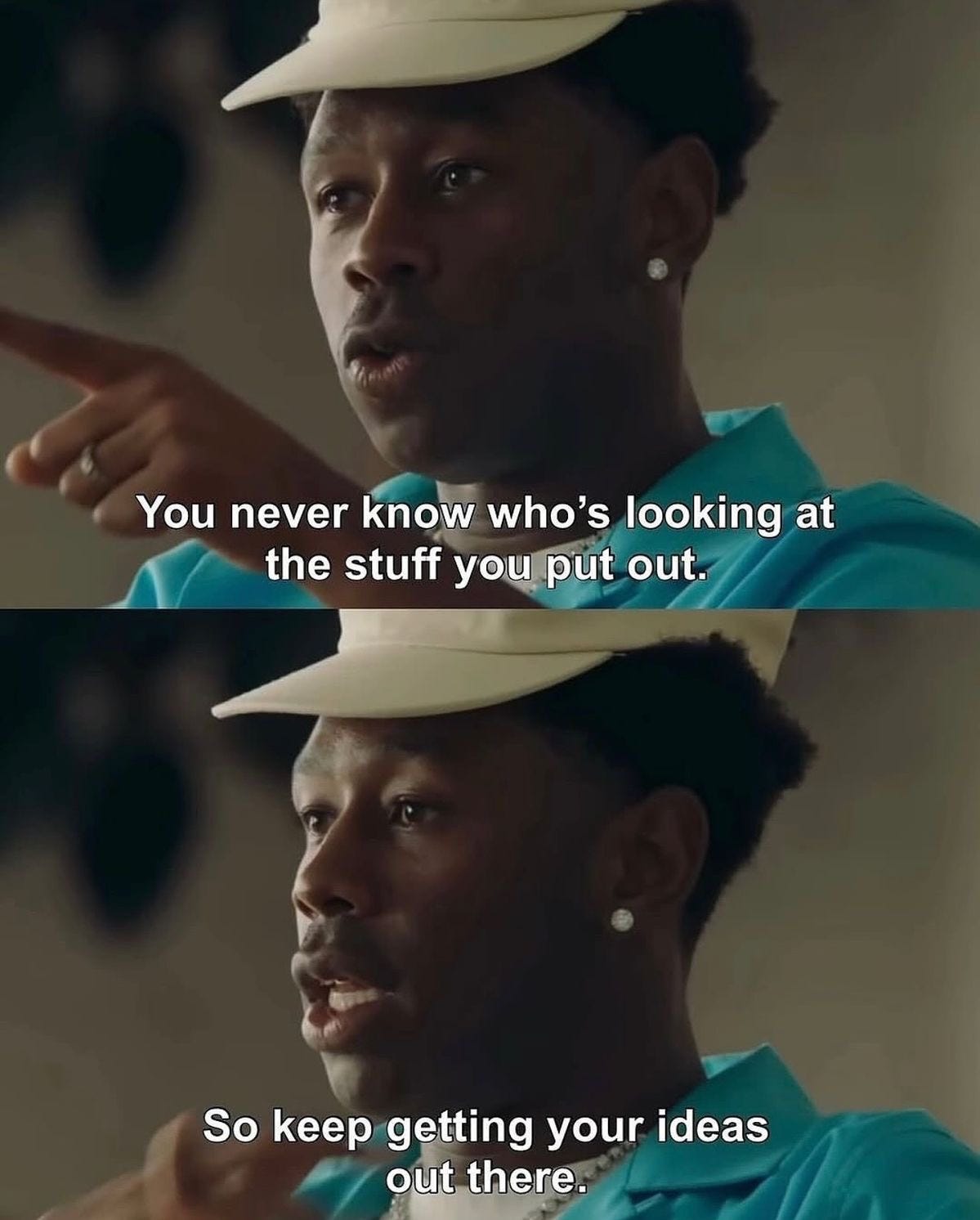
9. we’re in deep discussions with a really cool editorial outlet. i mentioned this before, but you don’t know who’s watching what you’re doing. and actually, 95% of people are watching without commenting. so that EIC i mentioned before followed up and we’ve been talking with their team for something really fun. and the beautiful part is they are interested in what we are already doing. and regardless of what happens, the exercise and journey with them has reaffirmed that the practice is the point.
what we’re focused on next
10. getting better at headlines. slow and steady wins the race. the first focus was getting into a rhythm of writing and publishing consistently. now, the goal is to focus on better headlines. you can write your heart out but if you don’t have headlines that grab people or are relevant to them, they’ll never see it. so i’m tapping my editorial friends to do some headline writing bootcamps and noticing what headlines are most intriguing to me the most. thennnn, after headlines, we’ll think about broader distribution. but no sense in trying to share what you’re doing offline if you haven’t mastered the best way to frame the story.
11. start telling other people’s work stories. every time i share my story, someone else shares theirs. we have all experienced so much trauma and pain and work. and we need to share them out loud with each other so we can start healing collectively, know we’re not alone and learn new ways to overcome and be in expression.
our hope is that follow the leader continues to be a place where we can talk about the universal human experience through the lens of work, the thing we all most have in common and where we spend the most time. we can never say it enough, but we are so grateful you are here – reading, commenting, sharing and encouraging us in our journey. it means everything.
until the next update…
sending u so much love,
m