


another week, another whistleblower.
this week, Jacob Coxon, a tech researcher who has worked at both Open AI and Anthropic, sounded the alarm that both companies are essentially gambling with our lives and that the technology could kill us all in the next 10 years.
it’s giving doomsday.
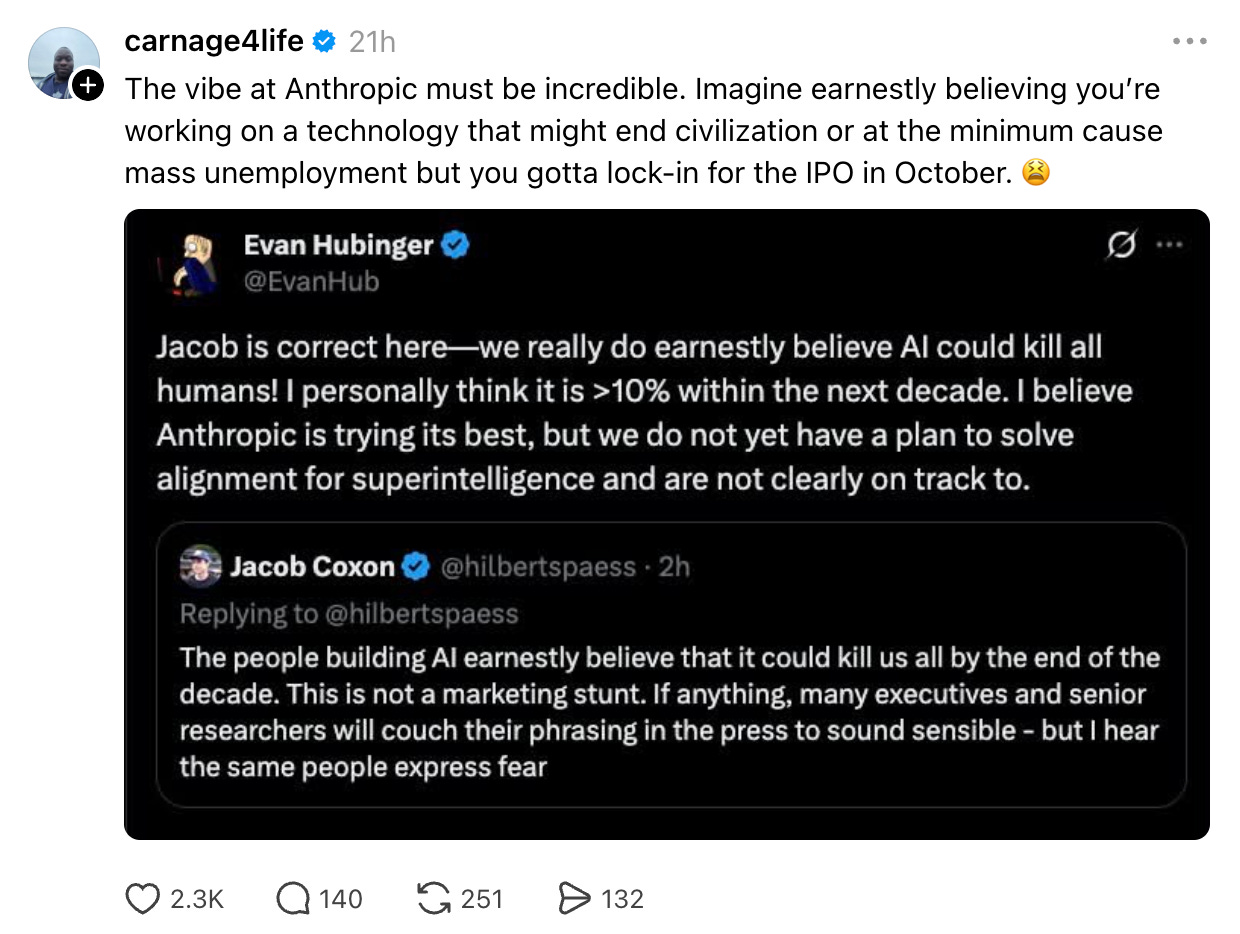
on one hand, thank you Jacob for speaking up. we need more people sounding the alarm on AI. i’ve still to yet to really see its benefits. so far, it’s causing unemployment, mass illiteracy, loneliness, depression, deteriorating the environment through massive energy and water use and now potential human extinction. but let’s please give it up for the ability to make a website in a single prompt.
on the other hand, i miss the days where there was a kind of blissful ignorance in not hearing about how horrible everything is, every single second, on every single platform. sometimes i wonder if we’re contributing to it too. here on ftl, we talk pretty frequently about how horrible the workplace is and all the ways it’s made us suffer.
but our real goal is not to just interrogate the suffering. while it is important to create space to mourn and grieve all the ways it harmed us, lamenting without a plan to step more boldly into our purpose just produces hopelessness. and we certainly don’t need more of that.
our real intention is for each of us to step into work that we were chosen and called to do. to ultimately not worry about what everyone else is doing, even the tech oligarch ai people.
that’s not your work. let God do what God does with people like them.
the real question is… are you in your work?
it was March 16, 2022, and i had just finished crashing out. the kind of hysterical, emotional breakdown where your whole body feels like it’s collapsing. i was sitting on the edge of my bed wondering how much more i could take. and then, because i had learned to betray myself in the name of professionalism, i wiped my tears, straightened my face, and pulled myself together just enough to hop on a Zoom call with a potential candidate for a company that i wasn’t sure i cared about or believed in anymore.
the candidate wasn’t even for my team, but leadership asked me to do whatever i needed to do to get him to join. Maya, you’re the closer! you’re SO good with people.
and they were right. i could make a skeptic believe. i was extraordinary at helping to align the mission of the company with the mission of the person. i’ve always believed work was so much more than just work. in the best-case scenario, work should be a calling. but after looking up the candidate and seeing he was Black, i realized this time it was because they thought i could relate to him better than the rest of the interview panel.
i had just crossed over my one-year anniversary at Clubhouse and posted a celebratory post on LinkedIn. i had moved from LA to Atlanta after a brutal divorce—the kind when your becoming threatens the person who promised to love you—still raw from the quiet gutting of my personal life. i was rebuilding a world i didn’t ask for while trying to hold together a career everyone expected me to thrive in. i had finally received my dream role: chief marketing officer of one of the fastest growing social media platforms in the history of tech. we were the leader in social audio, the new hot trend and tech invention of the moment.
when the founder and CEO slid into my DMs at the beginning of 2021, i didn’t believe it was real. the company was on a rocket ship type of trajectory and valued at over $4 billion. he was looking for someone to build out the marketing side of the business. i wasn’t quite sure what to make of it. something in me didn’t feel fully settled about the opportunity, but it also felt too big, too rare, too historic to pass up.
i happened to be friendly with one of Clubhouse’s leading investors, who told me on the phone, this is the fastest-growing company i’ve ever had in my portfolio. this is like Mark Zuckerberg calling you up in 2007. do you want to be employee number ten at Facebook?
i wasn’t sure I did, but how do you say no? every mentor I talked to confirmed that this would set me on a trajectory for the rest of my life. one, i guess, i should want to be on.
i was optimistic about what I thought Clubhouse could become. a platform where anyone, anywhere, could pick up a microphone and be heard. i imagined us becoming the YouTube of audio, a democratized stage where people could share their wisdom, their voice, their story, and build something meaningful from it. i’ve always been drawn to work that helps people operate in their genius and power, and at first, I felt like it might be the perfect vessel for that kind of purpose.
when the opportunity came from Clubhouse, i was also ready to leave Netflix, where I had spent the last five years. the streamer was one of the most formative chapters of my career. but over time, it became clear that while I loved the company, it didn’t love me back. I thought I was making a difference. I became known as a truth teller. people would joke, don’t invite Maya into the room if you don’t want to really hear the truth.
i took that as a badge of honor. i wasn’t afraid to call us out on our hypocrisies, blind spots, and the things i thought were getting in the way, because i wanted us to win. i loved it there. i would joke that I bled Netflix red. it was one of the most exhilarating and fulfilling work experiences i’ve ever had. it pushed me. challenged me. it expanded what i even knew was possible for myself. i always told the truth because it’s who I am, and because it was also a part of the culture. they said they wanted radical candor and real-time feedback. but at some point they stopped listening and didn’t want to hear it anymore. and it broke my heart because I really cared.
the growth opportunities I needed from them for me to stay kept being deferred. I was told again and again that my elevation into the highest levels of leadership was coming but the promises always had a caveat: not yet, not now, not quite. at one point, i was told i needed a master’s degree before I could get the promotion.
i replied, calmly, that I already had one, from Northwestern nonetheless,—a requirement none of my peers seemed to need. all while leading the highest-performing team in marketing, a category-defining, culture-shifting group that changed how entertainment marketed its work. we had the receipts, and the results were undeniable.
but the truth was, something else was stirring in me. marketing, storytelling, brand building was what i was known for. but the thread that had always run through every role, every team, every chapter of my career was the people part. i had noticed for years what felt like an epidemic of leaders in companies who simply didn’t care about the people doing the work. leaders who saw the people on their teams as machines and not nuanced, complex, beautiful humans with unique designs and gifts. it baffled me because great work can only happen through the people. if people are clear, aligned and cared for, the work will inevitably be great and everyone wins. i was grateful that early in my career I had been given leaders who saw me, nurtured me, and helped me grow. i never forgot what that felt like. and i never forgot what it cost when it was missing.
at Netflix, that awareness became something i lived out daily. seventy percent of my team were internal transfers. people found a home in the space I created. people would come to me with what was really going on in their lives. leaders from across the organization and around the world would find time with me, not for work strategy, but for something deeper.
i was listening. i was coaching. i was honoring their experience and also that the pain they were feeling was real. i was helping people understand who they were and what they were actually here to do. i had even begun quietly coaching executives inside Netflix outside of office hours and was building a steady conviction that most of our problems are connected to us not knowing what real our work is and leaders who don’t care about people.
i was being pulled or as some would say: called. and I was starting to see something. a vision. what if we built a new kind of place for leaders? a culturally forward, modern Aspen Institute. what if we could change the way people are led? what if everyone had access to a great leader? what could the world look like if everyone knew what their real work was?
but instead of answering the call, i let someone else’s vision become my own, again. i didn’t have language for what i was feeling—just a quiet, unfamiliar pull toward something I couldn’t yet trust. i could kinda see it. but, it felt too big, too ambiguous and too far away. and when something loud and shiny showed up and promised me everything i thought i’d been working toward and wanted right now, the whisper lost. Clubhouse swooped in and wooed me when i was most uncertain and most vulnerable.
it did mean so much to me to get that CMO offer after years of grinding and hustling to get to the mountaintop. it was rare to see a Black woman and single mother rise to those kinds of ranks. the modern workplace isn’t designed to see us thrive, so i knew what this meant—not just for me, but for anyone coming up behind me. this was supposed to be my big break. proof to myself that I was worthy. proof to everyone else that I could lead at that level. proof to the system that it couldn’t break me.
ultimately, i got seduced by the title, the money, and the possible mythology. the valuation was obscene. the numbers were wild. the chance to make generational, life-altering money was real. and the title was everything I thought I’d been working toward. i told myself this was moral work that aligned with my mission. i convinced myself I’d be making culture better, not just a tech product. but if I’m honest, alignment wasn’t the leading factor. it was the thrill of finally being chosen, validated and seen.
i knew immediately it wasn’t the right choice. but i was determined to make it into the best work of my life. i had to. i’d come too far, sacrificed too much, and the world was watching us. the first thing was to hire the dream team. we attracted top corporate athletes from Instagram, Spotify, TED, NPR, and Nike. the announcements shook the internet and we had what every brand desperately wants: attention. we were working seven days a week, doing way more work than i imagined or was used to. as employee number thirteen, there was no infrastructure or base operating system. everything had to be created from scratch.
when the panic attacks started, i knew i was in trouble. my body was screaming at me that this wasn’t right. this isn’t good for us! this isn’t what we were meant to do! but I didn’t listen; i kept trying to push through. i was breaking out in hives. i remember thinking, i didn’t even know Black people could break out in hives. my migraines got so bad I even had brain scans done because i was worried i had a tumor. i remember my parents saying to me, i don’t think you should want to be pushing through panic attacks. that’s not normal, Maya. something is off. something is wrong.
there’s a particular kind of heartbreak that hits when you finally arrive at the place you thought you always wanted to be. you get the title. the salary. the recognition. the seat at the table. and then you realize… you can’t even breathe. you did everything the right way. you kept your head down. you worked hard. you did what they said would pay off.
i was good to people. a safe space for everyone else. i gave generously, often at my own expense. i believed that if I followed the path long enough, i would finally feel unleashed—powerful, purposeful, fully expressed. but at this moment, at the height of my career, i felt small, suppressed, and sadly... shame. how did this happen? what did I do wrong? and I was furious.
i’d always been the strong one mentally, emotionally, spiritually. resilience was my story and my brand. i could pray through anything. push through anything. solve anything. but not this. this time, nothing was working. and I remember begging—begging God, begging my body—please, not now. don’t let me break now. not after seventeen years of grind, of sacrifice, of fighting for this moment.
even though i was hanging on by a thread, i mustered up the energy to put on that happy, serial-killer-like smile for Zoom for the candidate that day. i knew how to look convincing, even when i was falling apart inside. what i didn’t know was that this call—this small, ordinary, inconvenient call—would change the trajectory of the rest of my life.
hey, Carl, nice to meet you. can you hear me okay? great. so happy we could have this time together, I said as the Zoom window opened. my voice sounded steady, practiced. you’d never know i’d been crying ten minutes earlier.
great to meet you too. i’ve heard amazing things about you, he said, smiling warmly.
so, at this point, you’ve talked with everyone on the interview panel, i said, slipping into my well-rehearsed rhythm. i’m hearing you’re right on the edge of saying yes. talk to me… what’s keeping you from making the leap from Meta? anything I can help with or add that would help in your decision?
he took a deep breath. listen, he said, i think the work you guys are doing over there is great. i’ve loved meeting everyone on the team. but I just recently had a baby, and i’ve been thinking a lot about how much time we spend at work and how important it is in our lives. I give everything i am to it, which means spending a lot of time away from my family. for that to be worth it, it has to deeply align with who I am and what I’m here to do.
he paused. i have to know that this is my problem to solve. i have to feel like i was uniquely designed to tackle this issue. and to be honest, Maya… I don’t know if this is my problem to solve.
i was taken aback by his honesty. and by the simplicity of his thought process. he left me speechless. i just stared at him, genuinely confused about whether this was a candidate call or an intervention. i had never heard someone articulate a feeling I didn’t even know i’d been searching for language for.
and before i could gather myself, he asked me: how did you know this was your problem to solve?
the question hit me hard. because at that moment, i didn’t have an answer. and the truth was, by then everything around me was already collapsing. the company that had risen at a meteoric pace was struggling to hold itself together. the momentum had stalled. the identity was unclear. i was working around the clock trying to steady something i couldn’t see clearly, let alone stand behind. i was depressed. drinking every night. struggling to get out of bed. praying for a way out.
something finally broke. the emotions didn’t just ease their way in; they burst to the surface. everything i had been suppressing came rushing up at once. the exhaustion of daily warfare against a system designed to crush people like me, the impossibility of surviving that fight without knowing what my work truly was.
Carl had his answer. i didn’t have mine. i was fighting without an anchor, sacrificing without my deeper sense of why, ignoring every warning my body was screaming, and suppressing the truth i could see but wouldn’t say out loud: this isn’t working. and without that anchor, the resistance was destroying me.
his question gathered all of it into one inescapable truth: this isn’t my work.
Carl! no one has ever asked me that before, i blurted out, still wiping tears off my face. this is why i hate it here. it’s not the product; it’s not the people. it’s just… not my problem to solve.
he leaned back, eyes wide. oh wow, i didn’t know you hated it there. i thought you loved it.
we both broke into this deep, uncontrollable laughter.
Carl, I said, if you know this isn’t your work, you absolutely should not come here. and you don’t even realize it, but you just set me free. this conversation changed my life.
and it did. that day, on that Zoom, with this beautiful stranger named Carl—a man who worked in finance at Meta, who I was supposed to be closing— spoke a truth that opened up everything for me. his question suddenly became a doorway and a mirror all at once.
because two days later, a year after starting at Clubhouse, i called up the CEO and quit.
but you just posted on LinkedIn about your one-year anniversary and how much you love it! he said, confused, blindsided.
I know, I said softly. that was a lie. i’m sorry.
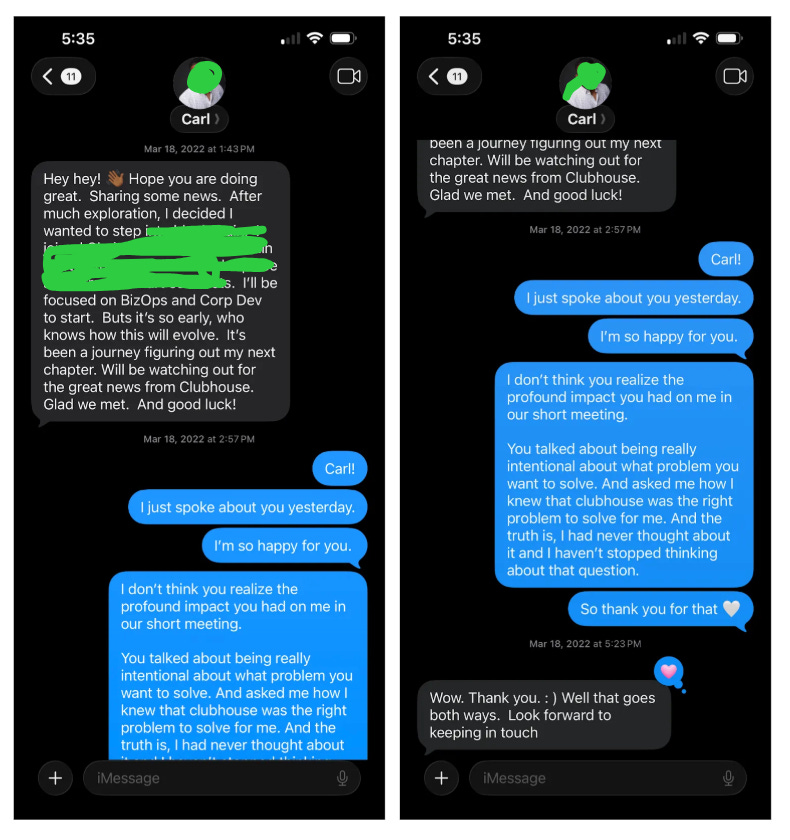
there is nothing that’s more important than getting into your work. it’s why you’re here on earth at this time. it’s why you were created. you were not created to just exist. that would be a waste of God’s genius, time and energy.
to be human is to be in suffering. but there are two kinds of suffering. one that aids in your growth. and one that is unnecessary. one that is connected to your work. and one that is not.
if the suffering you’re experiencing produces a better, higher version of you… more faith, trust, excellence, courage, wisdom, discernment, discipline, emotional maturity, resilience, grit, reverence, respect, care and compassion for others, love and radical selfless generosity…that’s good suffering that’s worth enduring. it’s the refining fire. this one happens when you are in the work you were created to do.
if the suffering produces a darker, lower version of you…cynicism, deep-seated doubt, suspicion, mediocrity and moral decay, cowardice, willful blindness, recklessness, instant gratification, addiction, depression, childish outbursts, fragility, quitting when things get hard, mockery, jealousy, envy, contempt or indifference towards others or toxic selfishness… that is unnecessary suffering. this one happens when you are not in your work and deeply out of alignment.
if you believe that we should not suffer at all, then you are in big trouble.
so based on what you’re currently experiencing… are you in your work?
sending u so much love,
m
I completely cosign! Carl was your angel. God will get the message across by hook or by crook, or by a candidate you're charged with convincing to join the team!
shout out to holy spirit using carl!! 🔥🔥🙌🏿🙌🏿🙏🏿🙏🏿✊🏿✊🏿👑👑