


i’m not sure if you saw the news about Jalen Hurts, the Philadelphia Eagles Super Bowl (and fine) winning quarterback, but apparently after reporting a leg injury, an ultrasound in London revealed Hurts had a superficial blood clot in his calf. and instead of prioritizing his health and sitting him down, the team’s medical staff—with backing from the league—cleared him to play.
it gets worse: Hurts spent the night before the game in a London hospital until 4:00 am. early reports even revealed he went nearly 36 hours without sleep because doctors advised him that sleeping was a risk. he played the game exhausted, and then the team put him right back on a grueling 12 hour flight home. unsurprisingly, a follow-up ultrasound back in the States showed the clot had moved. it traveled directly to his lungs, escalating into deep vein thrombosis and bilateral pulmonary emboli. he is now on blood thinners, out for the season, and by the grace of God still alive.

and I have so many questions…what information did Jalen actually have in that moment? did he even know what was happening and decide to just push through? did the owners force his hand because it was an international game and they were chasing new global revenue? is there some deep-rooted resentment here because they just hate seeing a Black quarterback succeed at this level? did they consider that even if the worst happened, they’d just collect the insurance money anyway?
and you might think, there is no way they would intentionally do that.
but what’s wild is that the ftl convo club is reading Colin Kaepernick’s new memoir, The Perilous Fight, this month. and two days ago, i was reading chapter 7 where Colin shares this crazy story about suffering a really bad leg injury toward the end of his college career. the team doctors told him it wasn’t a big deal, that he was totally fine, and that he just needed to get used to the pain. so he pushes through the pain to finish out the season, competes at the NFL Combine, does great, and gets drafted by the Niners. but then the Niners do their own medical evaluation, and they tell him he literally has multiple fractures in his leg. his college team doctors completely withheld that information from him so he would keep playing.
the parallels are…striking.
all of this just made me think about you. because even though you might not be a Super Bowl-winning quarterback with a $250m contract, you are a top athlete in your field. and i know you feel stuck and trapped in a situation where you know the leaders are straight-up lying to you because they’re too afraid to tell the truth. and you are completely exhausted from constantly shapeshifting and trying to guess what they want just to make them value you. even though we might not have physical blood clots or broken legs like Jalen Hurts or Colin Kaepernick, we definitely have psychological, spiritual, and emotional injuries that completely change how we play the game.
quick story…
Netflix was a company i admired for a long time. so, when they reached out and made me the offer in 2017, it was incredibly validating, and I felt like I’d graduated to the big leagues. in many ways it was the perfect company for me – it had an iconic culture. they hired brilliant people. gave them freedom and autonomy, paid them extremely well and made sure they had everything they needed to do the best work of their lives. if you weren’t able to deliver at the level they expected, they would tell you bluntly, give you a generous severance package and keep moving. it felt generous, transparent, honest and direct.
within a year of walking into that building, everybody kept telling me how great I was. they kept saying I was poised and primed to be promoted to the most senior levels of the company. i wasn’t even asking for it—the team was expanding, and there was just so much natural room to grow.
by all measures, my team was crushing it. we were producing industry-shifting work, memorable campaigns, and growing our side of the business. people wanted to work with us because we were healthy, really happy and operating in our zone of genius. i was a strong and influential leader in the company. so it was natural that when my own leadership and leadership several layers above me proactively expressed plans to elevate me further, i started to want that for myself.
in order to be promoted at Netflix, there were a few requirements. first, there had to be a business need for the role and they wanted to see you already operating at the level you were trying to reach. so, since I was a Director trying to jump to a VP level, they wanted to see me already moving, acting, and thinking like a VP. on top of that, you had to show clear evidence that you had completely mastered the company culture and successfully moved the business forward through your specific domain. and, other VP leaders across the company had to weigh in on whether or not they thought you were “worthy” of the promotion.
your direct manager would write up a formal memo—basically building a legal case for why the role should exist and why you deserved it—and they’d have to go around and “sell it in” across different parts of the business.
so within a year of me being at Netflix, my manager told me he was already starting to work on my promotion memo. he said it was actively being circulated to other leaders across the business and everyone was supportive.
and that’s exactly when the goalposts started moving.
first, the sitting CMO left the company. and leadership announced they were halting all promotions across the entire marketing org until they could find a replacement. it sounded logical and honest. but then, over that next year, i watched at least four of my peers get promoted, despite the fact that they weren’t coming anywhere close to the kind of impact i was making, both internally and externally.
when I asked why, there was always some super special, never-before-heard-of exception as to why these specific individuals absolutely needed to be promoted right then and there.
um…ok.
a year later, they finally hired a new CMO. she immediately announced she was opening up a VP role in the exact function that I had built, created, and led. so naturally, I thought I was a shoe-in, or at the very least, that I was going to be considered for it. but when I met with her for the first time, she told me straight up, cold and blunt, that I wasn’t even going to be considered for the role.
when I asked why, she didn’t have an explanation. she basically said, that’s the way it’s going to go, and that she was bringing in someone from the outside. i tried to push back. i asked if I could at least be the internal candidate. she said no. i asked if I could step in as the interim VP until they hired someone, just so they could see me actually doing the job. another flat-out no.
i can understand a leader wanting to bring in their own talent and establish their own regime when they take on a new role. that’s just standard business. but she couldn’t or wouldn’t even say that.
for nine months, i watched them interview person after person and completely fail to find a single viable candidate. i couldn’t take it anymore and i pushed back again. i asked them, “why am I not ready for this role again? why won’t I even be considered? you all need to give me some actual answers because this doesn’t make any sense. and frankly, i am owed that.
a few weeks later, they finally came back with their feedback…
the first thing they shared is that i needed more experience. when i dug into what they meant by that, they said i needed more time under my belt doing the work i was already doing. i guess my ability to build this entire team from scratch and produce results wasn’t enough evidence that I was capable.
the second point was that I needed to do a better job managing up. now, that part was actually fair. i hate managing up to people, i always resisted the bureaucratic nature of it, and i tended to just keep my head down and focus on protecting my team.
but the third point was infuriating. they told me I needed to develop more as a leader and grow my business acumen—which, by the way, i was hearing for the first time. they casually suggested that maybe I should go back to school and get a master’s or an MBA.
i just looked at them and said, i have one.
i let that sit in the air for a second, and then I asked: was that also a prerequisite for the five other people who got promoted in marketing this past year, or is that just for me?
at that exact moment, everything became so clear to me.
i remember thinking, oh,you don’t actually want me here. you aren’t interested in genuinely getting to know me, you don’t care to see me thrive, and something about my growth and my elevation makes you deeply nervous and insecure. and you’re never going to tell me the truth.
they tried to pacify me by committing to a six-month plan for my promotion. i never heard from them about it again. not a single check-in. so, when those six months were up, i told them i was leaving. literally a week before my last day, after I had already accepted and announced a new job somewhere else, they called me back and told me they wanted to give me the promotion.
I just told them I wasn’t interested and moved on with my life.
but i was completely disillusioned, heartbroken and sad. i loved the work, I loved the people but i was so mad at myself for letting myself believe them. and for a long time, i questioned if i even was the leader i thought i was.
i used to think if I just worked hard enough, if I was loyal enough, that things would be different. but i finally had to accept that the system is never going to care for me as a person—they can only ever see me as an asset for capital gain.

their job is to extract everything they possibly can from you and then discard you when they got what they needed. and that is by design. the whole point is to lead you on, tell you they care, get you to believe in their mission, get you to work as hard as possible and then they slowly break your spirit and exhaust your body. they do it on purpose so you don’t have enough energy left to fight back, and so you stop trusting yourself enough to believe you deserve better.
the more you push for the truth, the more you are seen as a direct threat to the system—because the entire machine runs on compliance, secrecy, and lies. if they can keep you in the dark, they can keep you under control. but once you start questioning their narrative, the illusion falls apart, and they lose their leverage.
that is why they fight so hard to hide the truth, whether it’s an injury report in the NFL or a promotion plan in a corporate office. they know that a worker who knows their worth, and sees the system for what it really is, they can no longer be controlled.
this means you need to stop looking for validation and truth from a system that is fundamentally incapable of seeing your humanity. if a multi-billion-dollar empire is willing to gamble with the actual lungs and life of a superstar like Jalen Hurts, you have to be completely honest with yourself about what your company is willing to do to you.
but once you can see it for what it is, that’s when you get your power back. you’re able to look at the field, see the game and start moving accordingly. because the moment you stop trusting their lies and start trusting yourself, you become the one thing the system can’t control: free.
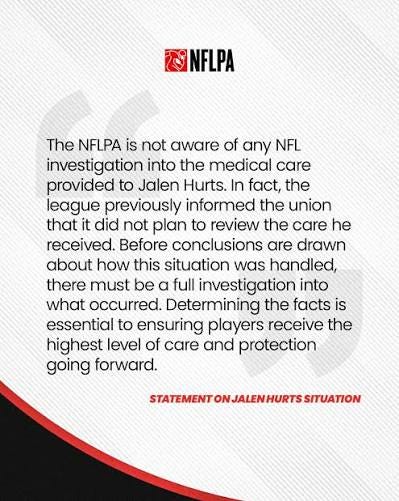
The NFL tried to clear the Eagles of any wrongdoing almost immediately, but the Players Association (another case for unions) said not so fast and is calling for a full, independent investigation. it is so rare to see literally every single sports commentator and pundit completely aligned on something—from Stephen A. Smith to Ryan Clark to Shannon Sharpe to opinion articles in the New York Times, everyone is saying something feels awfully dark about this one.
but one thing we know to be true is that everything that happens in the dark eventually comes to the light.
sending u so much love,
m
I’m only halfway into this essay, but I literally felt myself clenching my teeth/jaw while my stomach sank because this is a painful realization many of us overachievers/chronically excellent have experienced in our careers. It’s not a good feeling.
As I dive deeper into the grief of failed expectations, coming to terms with the reality of the workplace treating employees as expendable has been one of the toughest. Meritocracy is drilled in us as the rule of the game, but there's something more sinister underneath and when you realize it, it's heartwrenching. Jalen deserves better. You deserved better. But then, what do we do with that?