


last Friday afternoon around 3:37p, Kevin Stuckey and i had just wrapped our first official Substack review meeting. how’d we do? who showed up? what are we learning? and based on that, what do we need to be in practice of next week? we had finally closed our laptops, pleased with our progress and witnessing the micro and macro impact of being in expression of our thesis: what happens when we show up every week and share the truth of our stories?
we were starting to relax into the weekend while we waited for Chipotle to arrive. we don’t cook on Fridays. as we walked out of our meeting room, i overheard Kevin playing this clip of Ryan Clark getting emotional talking about being fired by ESPN. I asked what happened, but Kevin was still gathering the facts and wasn’t sure yet.
when we got to the family room, Kevin sank into the couch while i started impatiently grazing for snacks in the cabinets.
did you see LeBron is going to Philly? he asked.
ugh, he’s so lame to me! why in the world would he go to another team? and why Philly?! i said so annoyed.
Kevin started reading some facts and commentary he saw on Threads about the move. $8 million contract. 24 months. the team with Jaylen Brown, Joel Embiid, and Tyrese Maxey. And a chance to win another championship with yet another team.
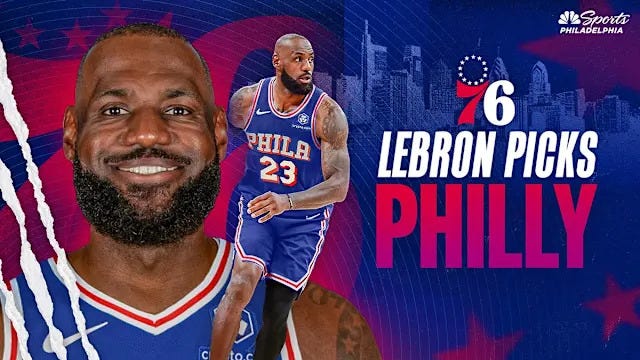
it’s so interesting, I said. Lebron might be the first NBA great that’s not associated with one franchise. there’s Jordan and the Bulls. Bird and the Celtics. Magic and the Lakers. Tim Duncan and the Spurs. i don’t know if there will be one team we’ll remember LeBron for.
Kevin said, yeah that’s right. i think that’s the point. we’ll remember him as Lebron, inc.
i stopped eating the handful of cashews i had grabbed and suddenly remembered that we are supposed to be employee first, and in this instance, player first. my disdain with LeBron stemmed from an old construct and the outdated mindset that to be great it meant you stayed with a franchise and they built the team around you. you didn’t leave when things got hard or through losing seasons. you stayed, endured and your ability to win at one place is what made you a legendary player.
and then Kevin said, Lebron is just the Bozoma Saint John of the NBA.
i looked at him wide eyed and said, we have to write about this.
we have good news
it was a hot July summer day in 2020 and i was anxiously pacing back and forth trying to stay in the light that was shining in through the floor-to-ceiling windows inside my Sherman Oaks house waiting for the two highest ranking Netflix executives to call. i had just returned to work after taking two weeks off after a deeply visceral and unpleasant encounter.
we have good news, Reed Hastings said over the phone to me. thank you for your patience over the last couple weeks. we want you to know we really value you and want you to know how much we really believe in you and your future here. we took action and let what’s her name go. it was clear she was struggling and it was unacceptable how you were handled. the good news is we hired Bozoma Saint John. she starts in September. you now report directly to her. you now report directly to a Black woman. isn’t that great news?!
i paused in shock. uh…yeah…wow. i didn’t see this coming.
Ted added, she’s been briefed on your situation. and even though she doesn’t officially start for a couple months, she wants to talk to you today in the next hour if you’re available.
yes, of course. tell her i’m free. I said back. i’m really grateful you all took action on this. it means a lot to me. i really love this place. i was waiting to see how you all handled this over the to see if i was going to stay. and based on this, i’ve made the decision to stay. thank you.
we hung up the phone and i immediately texted one of my trusted work besties who knew the details of everything that had happened leading up to this.
me: they fired what’s her name. And hired Boz.
trusted work bestie: alkdafljhdsfy!! what?! omg. how do you feel about this?
me: i don’t know how to feel. i’m talking to her in an hour.
trusted work bestie: what are you gonna wear?
me: idk yet.
her image rewired my imagination
i had followed Boz’s career for years. i distinctly remember being mesmerized by this image of her in Fast Company after she demoed Apple Music at Apple’s iconic developer conference in 2016. who was this gorgeous, glamorous, dark-skinned, big hair, don’t care Black woman in marketing? i thought. i immediately looked her up to learn more about her journey and resume. Spike Lee. Pepsi. Beyonce. wow. impressive.
when I was still at OWN, i had bumped into her a couple times when she was one of our VIP guest for the irl experiences we were producing at the time. we always did that Black woman i see you thing from across the room. we only spoke in brief sentences. she was always kind and polite when i saw her backstage at SuperSoul Sessions and The Life You Want tour.
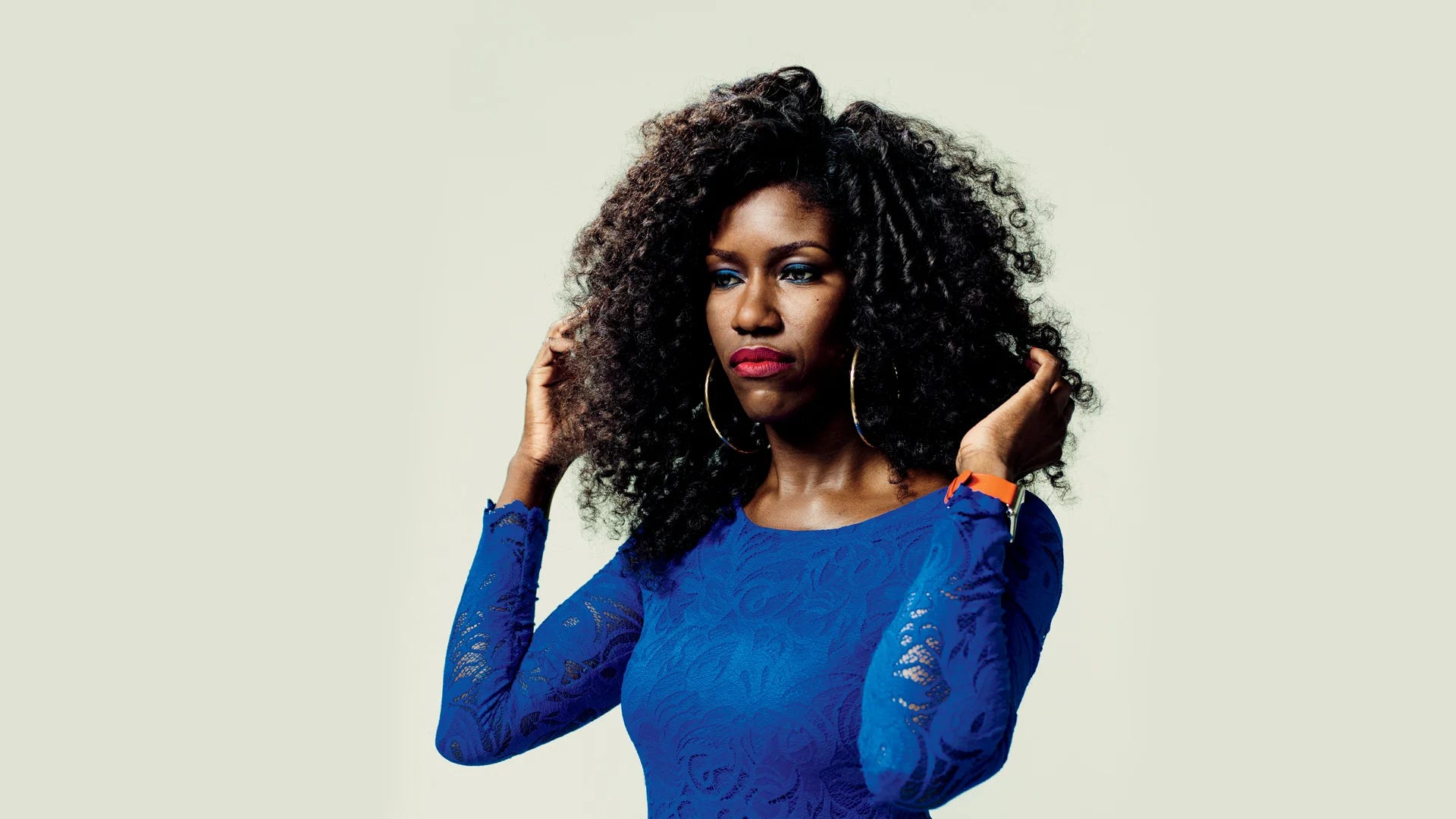
her presence was a physical force. you couldn’t look away from her if you tried. it wasn’t just the sheer height, the kaleidoscope of colors she wore, or the majestic crown of her hair. it was her posture. her poise. she carried a laugh so resonant and a confidence so thick it permeated the air, giving it no choice but to settle directly on you.
i had never seen anyone who looked like that, and definitely anyone who looked like me, occupying the exact rooms i desperately wanted to enter. before her, my ambitions were theoretical. her image alone rewired my imagination, fundamentally shifting the boundaries of what i believed was possible for myself. i didn’t just respect her; i looked up to her as a blueprint.
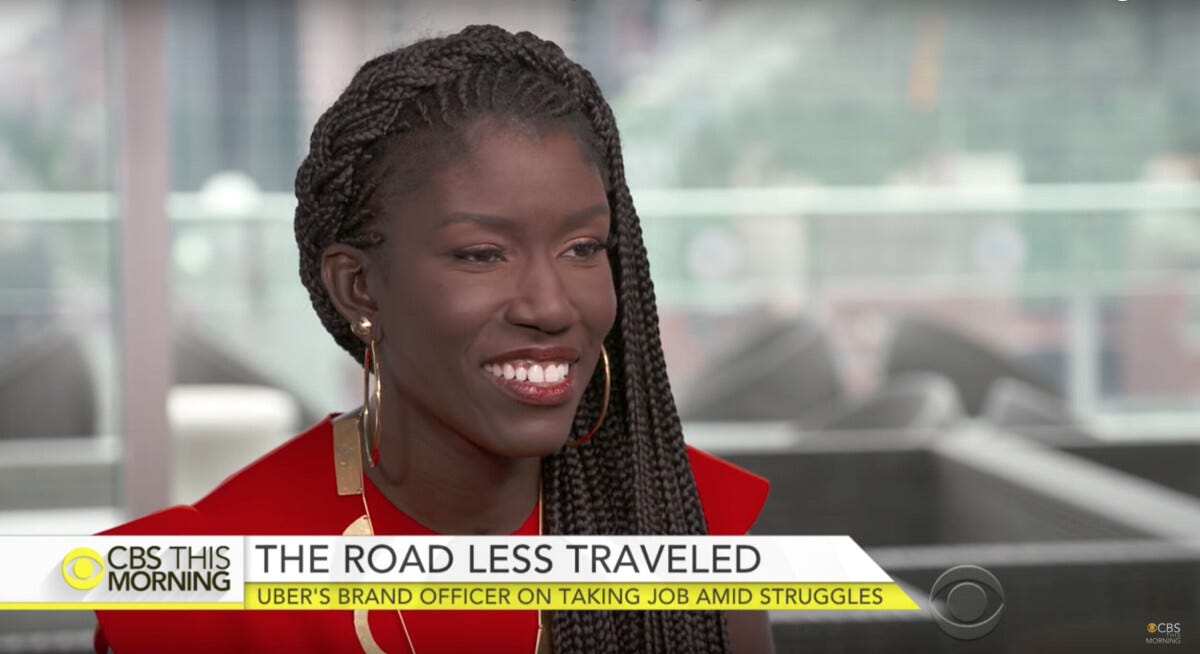
since then, i tracked her every move through Instagram and industry chatter. i vividly remember her breakthrough Apple Music campaign. the one with Kerry Washington, Mary J. Blige, Taylor Swift, and Drake. iconic, I thought. i had just started at Netflix in 2017 when i watched her sit down with Gayle King on CBS This Morning in a bright red blouse, gold hoops, and braids, thinking, man, she is bold. she had just moved to Uber, stepping in as the face of the brand in the thick of all the misconduct allegations surrounding Travis Kalanick. i knew what that meant: a massive job, a massive check, and massive pressure.
as i learned more about her personal history, my reverence deepened. i was a single mom myself, fiercely determined to climb the corporate ladder and make a name for myself. finding out that she had ascended to the absolute highest echelons of corporate as a single mother was profoundly comforting. it felt like a direct validation: if she could do it, I could do it.
less than a year into her time at Uber, she announced she was leaving for WME. with every rapid pivot from company to company, the narrative around her seemed to change. it felt like she was transitioning from a corporate executive deep in the daily execution to a corporate influencer. my admiration started shifting into suspicion. why was she jumping ship so often? i prided myself on being in the trenches, doing the actual heavy lifting. for me, leadership wasn’t about optics or the spotlight. it was about moving the needle and taking my responsibility seriously both to the internal teams I led and the external audiences we served.
on Instagram, her feed became a parade of famous faces and luxe experiences. it started to feel like her real work was simply being friends with celebrities and getting paid millions to do it. it felt insulting to those of us who kept our heads down, focused on the business, and did the real work. to make matters worse, the rumors started circulating: chatter that she would slide into a company, shake up teams and leave without ever executing the work. watching her get celebrated for optics while we bled for results turned my skepticism into resentment.
so when Reed and Ted told me they had hired her as our new CMO, it felt like a slap in the face. Netflix wasn’t a playground. we were a real company with massive deliverables and non-stop pressure. and after cycling through two CMOs in two years, our department was running on fumes. we needed a stabilizing force, a leader to anchor the ship. instead, it felt like we were getting a celebrity figurehead hired to pose for the cameras.
why are you still here?
but regardless of how i felt, she was the boss now, and our first meeting was minutes away. i was about to log onto a Zoom with one of the most blindingly glamorous Black women to ever scale the corporate ladder. i swallowed my resentment, grabbed my makeup bag, brushed my hair, and put on a red lip.
when the Zoom window popped open, she was smiling radiantly, her porcelain-white teeth flashing brilliantly against her rich, dark skin. she was in immaculate, full hair and makeup, looking every bit the icon she was. when she gestured, I noticed her long acrylic nails, adorned with intricate, colorful artwork. she was completely, unapologetically flawless.
she said, i’m so happy to see you. they told me what’s going on. then with genuine concern in her voice, she asked, sis, are you ok?
and i lost it. i just completely and utterly lost it. the unexpected softness and genuine care of a Black woman asking about my spirit completely shattered my hardened corporate shell. i couldn’t stop the tears if I tried.
as I choked back the tears and fought to steady my breath, the floodgates opened and i laid it all at her feet. i told her how I’d been at Netflix for four years, fed a steady diet of empty promises about reaching the next levels of leadership. i told her about the team I built, one of the most wildly successful marketing engines the industry had ever witnessed. a team where 70% percent of the talent fought for internal transfers just to work under me. everyone wanted in, but for leadership, it was never enough. i was invisible when it came to promotions, while my peers, who hadn’t delivered a fraction of my results, were constantly elevated.
the words just kept coming. i told her how i realized i was only valuable to them when the company was on fire with Black shit. when Black talent had a problem or Black employees demanded accountability or when our CCO was fired for saying the n-word, suddenly they needed me to play shield. i told her about the unimaginable names I’d been called, and the final, crushing blow two weeks earlier: being asked to co-lead the company’s Black Lives Matter task force, only to be called angry and militant and humiliated by another leader, in front of the entire executive team.
i told her i was done. that I’d threatened to walk, threatened to sue. threatened to burn Netflix to the ground. that the frustration from this place had bled into my home, leaving my personal life hanging by a thread. it felt like the walls were caving in, and i was suffocating. i was overwhelmed. and i was tired.
then, my voice shifted from a plea into something else. i began rambling about how grateful I was for her, how her very existence given me life at a time when i needed it, and how I couldn’t even fathom the horrors she must have survived to reach her heights. i see you too, I told her, the tears still falling. we’ve all been watching you, Boz. we had never seen anyone like you. thank you for being who you are.
in that space sat two Black women, stripped of our armor, recognizing the same battle scars on each other’s skin. i wasn’t just crying for myself anymore; i was honoring what it took for her to survive, too. the gravity of that mutual recognition, i watched her eyes start to water too.
she held my gaze, looked me in my eyes and said so beautifully calmly, if you’ve done all of that, and experienced all of that and they still don’t see you, why are you still here?
the ultimate permission
the silence that followed her question was deafening. it was the exact moment the old construct died. i realized then that the resentment I had harbored toward her wasn’t actually about deliverables, corporate stability or her fancy life. it was envy. i was bitter because she had a freedom I didn’t think I was allowed to possess. i had been trapped in the toxic ideology of the loyal employee, while she and LeBron were operating as players who owned the game. she wasn’t just a corporate executive; she was an enterprise. LeBron wasn’t just a basketball player; he was LeBron, Inc. they didn’t belong to the organizations; the organizations should feel blessed to have them.
her question forced me to look at my own hands and realize i held a power i didn’t know i had. that it was possible to be great, to deeply care about the work and the people and to stop waiting to be seen, waiting to be promoted, and start playing for myself. in that one sentence, Boz gave me the ultimate permission: the permission to leave.
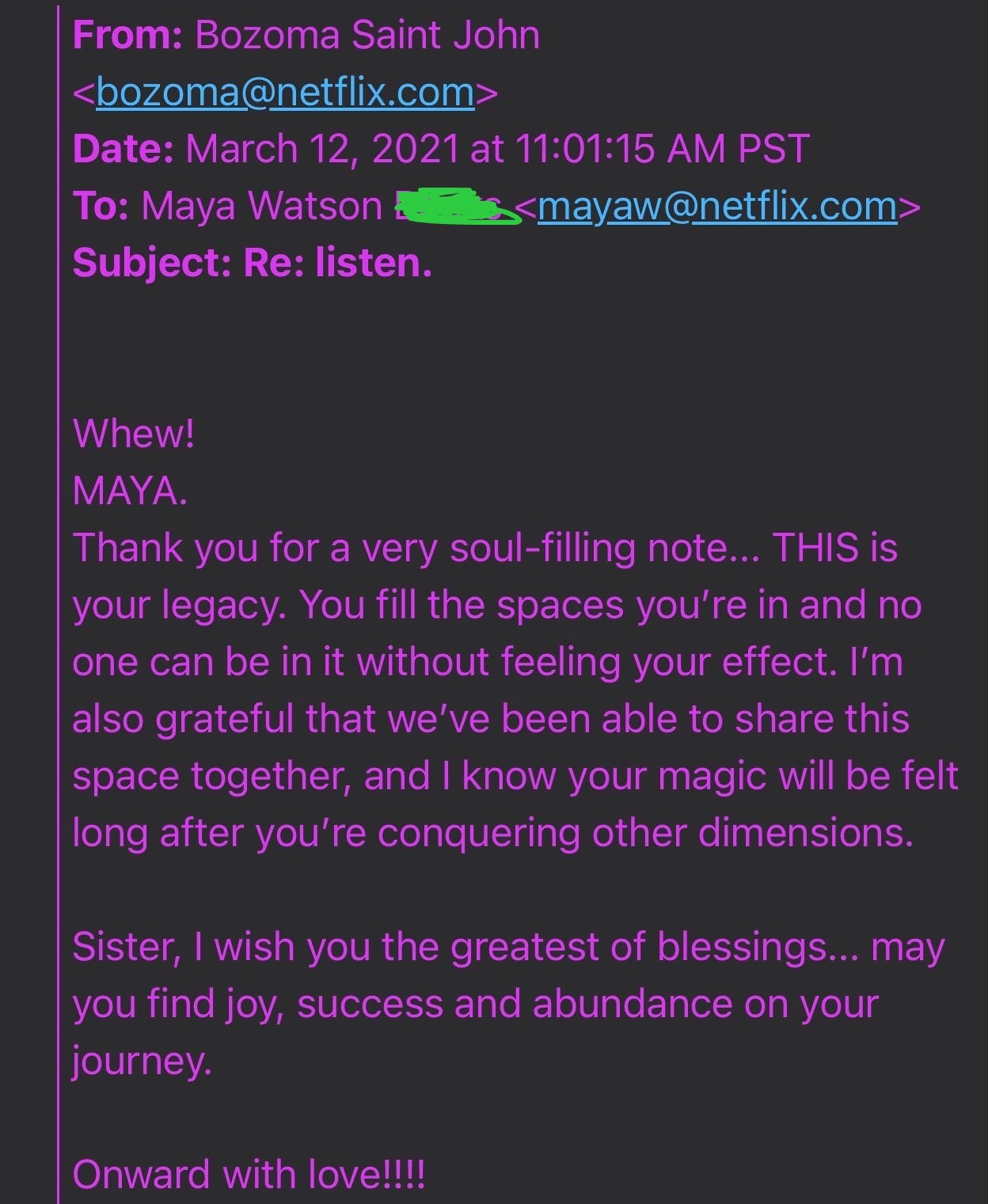
i started interviewing for a new team two months later. six months later i left and became a CMO.
work isn’t working
we are living through the most disruptive generational reckonings the workplace has ever seen. we are the most conscious we’ve ever been, armed with therapy, coaching, and unprecedented access to information. we’ve learned how to name our triggers, regulate our nervous systems, and advocate for our needs. this deep self-awareness makes it impossible to tolerate what isn’t right. we can see toxicity clearly now. We can name burnout, manipulation, and dysfunction. so when we say a corporate system isn’t working, we are not being dramatic; we are being honest.
the pandemic accelerated this shift. it forced a global pause that allowed everyone, everywhere, all at once to get quiet enough to hear the truth: work isn’t working for me anymore.
our parents and grandparents survived under a different blueprint. for them, a linear path existed. you clocked in, kept your head down, and trusted that institutional loyalty would reward you with stability and a pension. the system was flawed, but it was functional enough to build a life around.
but our societal contract with work is broken. and as author and workplace researcher Bruce Feiler notes in Life Is in the Transitions, that linear life is dead. Feiler’s data reveals that modern lives are strictly nonlinear, unfolding in unpredictable chapters, disruptions, and resets. we are changing industries, identities, and values multiple times over a lifetime.
the crisis we feel is that while our lives have become nonlinear, our corporate systems are still built for linear humans. companies have no sense of loyalty, commitment and decency to their people. the jig is up. our parents survived by staying put. but we have to imagine a new way. one where we move with a different kind of intention, authority and agency.
no one is coming to save you
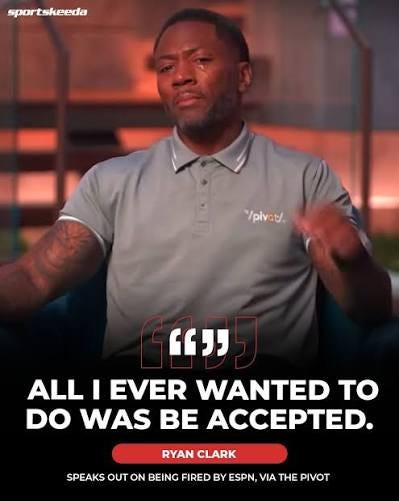
if you are still waiting for a company, a title, a promotion, or a manager to save you or to see how great you really are, you are waiting for something that is not coming. excellent work will not insulate you from a broken system. just look at Ryan Clark, pulled off the air mid-broadcast by a network he gave a decade of his life to for no valid reason.
the ground is moving under all of us. this is the moment our parents never could have prepared us for and the moment the modern corporate athlete must learn to lead themselves. so let the franchise keep its old playbook. let the traditional corporate map burn. the true measure of a legendary career is no longer how much dysfunction you can quietly endure for a title or a logo, but how fiercely you protect your own value and how much you deeply understand your own worth.
sending u so much love,
m
There's a conversation from a Boz interview that I included in my book because it radically changed how I thought about leadership and impact:
"The conversation centers on hiring, specifically how to interpret a resume.
Posner plays devil’s advocate.
"Some of your stints haven’t been that long. Would you consider yourself a job hopper? How would you evaluate your own resume?
Saint John doesn’t blink."
“Whether someone’s been in a job for six months or ten years, the only real question is this: what did you do there? How did you create impact? If they made an impact in six months, great. If they spent ten years doing one thing, I don’t want them.”
In one move, she reframes the conversation. Not by reacting defensively, but by exposing the flawed assumption underneath it."
This is the highest compliment: "before her, my ambitions were theoretical. her image alone rewired my imagination, fundamentally shifting the boundaries of what i believed was possible for myself." Now THAT is some EN-ER-GY! Dern. Maya please keep going!!! LOL some of this is triggering -but in a good way. It's unearthing memories I've buried and helping me as well!