


first and foremost, i’m really sorry.
no matter how much you might have been bracing for this, or trying to mentally prepare yourself, no one wakes up thinking today is actually going to be their last day. even when you know it’s a possibility—even when you know, logically, that this is something that is likely to hit everyone at some point—it is still a shock to the system. It is heartbreaking, disorienting, and honestly, humiliating.
right now, you are probably doing your absolute best to put on a brave face. maybe you’re telling your friends and colleagues that you’ll be okay, or spinning it as a good thing—a chance to finally pursue that project you actually care about or take the time you’ve wanted to take. you’ve likely had to handle the heavy burden of internal comms with your family, reassuring them that you’ve been responsible and that everything will be fine. and if you haven’t told anyone yet, you might be rehearsing the exact words to say.
layoffs have become such a normalized practice in our society that we forget that even our own department of labor calls it one of the most traumatic experiences you can go through in life.
i want you to know that in the last month alone, approximately 1,720,000 people were laid off. this means that every single day of the year, about 56,500 people are let go. that breaks down to roughly 2,350 people per hour, or nearly 40 people every single minute. it is roughly equivalent to laying off the entire population of Philadelphia every single month.
for context, this is about six times more than what our parents had to deal with. it’s very hard for them to understand our reality today. in their day, layoffs were concentrated shocks—rare, seismic events that felt isolated. today, layoffs are constant background noise.

i’m telling you this not to minimize what you are feeling, but because i want you to see the sheer scale of this issue.
you didn’t do anything wrong. this isn’t a reflection of your work, your value, or who you are. you didn’t fail. the machine is broken.
but how you process this moment right now is going to dictate how the next decade of your life. when a traumatic event isn’t properly processed, it acts like a compromised lens through which you view the entire world. it changes how you look at opportunities, how you trust people, and how you see yourself.
when our brains experience trauma, they instinctively look for someone to blame. if we don’t understand the real, external reasons behind a crisis, we unconsciously turn that blame inward. we start making up stories that aren’t true. but when you actually understand how the machine works, you see that the problem was never your worth.
why layoffs actually happen.
we obviously live in a capitalistic society, and the true engine of capitalism operates on a doctrine that the sole purpose of a business is to maximize profits for its shareholders, and nothing else. economist (and one of their kings) Milton Friedman explains, there is one and only one social responsibility of business—to use its resources and engage in activities designed to increase its profits so long as it stays within the rules of the game…
because a company is an artificial entity and not a person, it doesn’t have human responsibilities. Friedman believed that anyone who works for a corporation is contractually bound to serve the owners and shareholders above all else. the painful truth is, they never will and they can never, ever put you first. you are not their key stakeholder. you are just a tool and a vehicle for the real job of the business. and when the machine is done using you, it discards you.
this is why companies build sophisticated culture decks and write beautiful value statements telling you how much they care, how much they value people over process, and how they want you to do the best work of your life. they will use polished phrases about an unusual company culture focused on excellence or creating an environment where talented people can thrive. they have to say whatever it takes to convince you to give everything you are to them so they can get what they actually need for the person they actually care about.
in the same way big pharma is forced to list terrible side effects in tiny print at the end of a commercial, there should be a warning label on culture decks that says: results may vary. your livelihood will be terminated at any moment to protect a spreadsheet.
i personally don’t understand why the actual human beings who make up a company — pouring in their time, talent, and life savings of energy — aren’t considered of equal value to an outside shareholder. but whether we agree with it or not, every for-profit business leader has to subscribe to this doctrine without question.
the math behind layoffs.
they are always just figuring out how to maximize profit margins. profit margins are just a measure of how much money a company keeps after subtracting its costs. when a company is in a growth phase, they will happily pay top dollar to hire the best talent so they can leverage your skills to build their business. but once the business is successful and growth slows down, they immediately look to cut expenses to artificially pump up those margins. it’s a giant bat-signal to wall street to make the business look healthy for the next quarter.
in a healthy or traditional version of capitalism, a company grows by investing in its people, improving its products, and expanding its reach. employees are seen as the fuel and the builders of that growth. but in this modern, late-stage capitalism version of the game, the system has run out of normal ways to grow. to keep making stock prices go up every single quarter, companies have to start turning inward and destroying the very things that made them successful in the first place—their culture, their institutional knowledge, and their loyal, experienced talent.
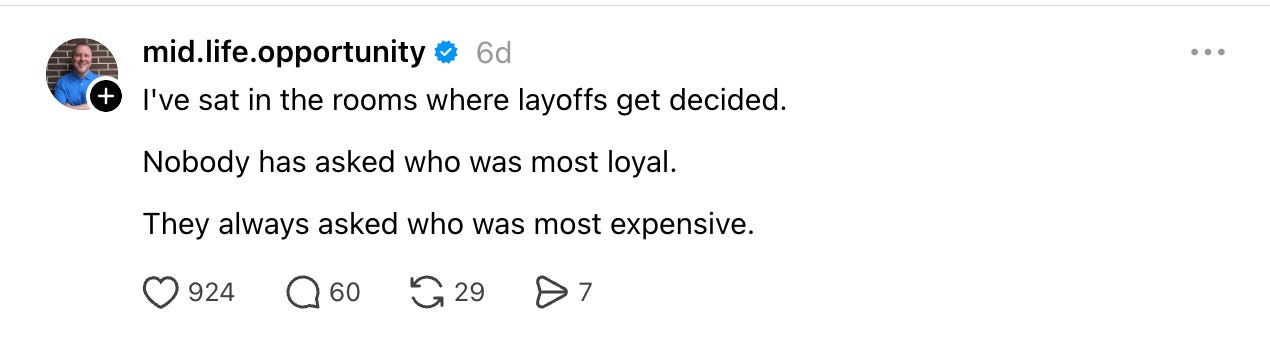
and because human talent is usually a company’s most expensive line item, it always gets targeted first. and often, they’ll cut the most expensive, tenured talent (except themselves, of course). if they do hire people back later, it will likely be younger, cheaper and less experienced talent just to keep those margins high. maybe they over-hired, or maybe ai is encroaching faster than we thought. but in either case, the underlying question driving their boardroom decisions is always the same: how do we maximize shareholder value right now?
or, to put it more accurately, how do we manipulate our numbers this quarter to make a group of wealthy strangers feel better about our business?
why layoff communication sucks.
the reality is, they aren’t actually writing those emails to you. they are physically incapable of telling you the truth. remember, you don’t matter to them. they are writing to Wall Street. they know the memo will leak, or they will upload it themselves to their investor relations page, because the whole point is to assure their first love that they are taking decisive action to protect profits.
the best kept secret in corporate america is that leaders want you to think they know what they’re doing. but we all know that the they literally have no idea. you are the one doing the work, bringing your wisdom, expertise, relationships and actually making things happen. while a CEO is measured on their ability to maximize margins, they are equally measured on their ability to perform certainty. they are paid millions of dollars to convince the public, the board, and the team that they have a grand, flawless strategy, even when they are just flying completely blind. they are not allowed to be seen not knowing.
this is incredibly disorienting for you as an employee. you show up every day and see firsthand that the company is a total shitshow mess. you see the incompetence, the chaos, and the constant pivots. yet, when you get laid off — the person who actual did the work — you don’t get any real clarity because they can never break character. they are compensated for how tightly they maintain the illusion of control. they are paid actors.
so, the email they sent about why they’re laying you off this has to be fundamentally dishonest to you because they aren’t talking to you even though they claim to be. it probably contains the same soulless script every single time: decisions like these are never easy, and we don’t take this lightly. but the truth is, these decisions are easy and light for them because not only do they not face the consequences, they make more based on how convincing they can be.

instead, they gave you some ambivalent corporate speak about how the business is strong and growing, or how they are going to handle you with care in the transition or that they have to make hard choices across the organization to keep delivering for customers, partners, investors and employees. notice the order of the stakeholders.
and then there is the absolute brutality of how it ends. one minute you are in the middle of a project, joking with your teammates on slack, and the next, your screen goes black. your email is cut off and your access is revoked. in a matter of seconds, years of your hard work – your blood, sweat and tears – your relationships, and your digital footprint are just erased.
this sudden digital exile is a deliberate corporate tactic disguised as security protocol. it is designed to isolate you so you don’t talk to your colleagues, stir up dissent, and more importantly to remind the remaining staff of how expendable they are too. but emotionally, it feels like being ghosted by an institution you gave your life to. it makes you feel invisible, like you never mattered.
this sudden silence isn’t a reflection of your worth; it’s just the final, cowardly act of a machine that doesn’t know how to look a human being in the eye when it breaks a promise.
why layoffs are so traumatic.
society has become completely numb to the real human story behind it all. the truth is, this moment is a catalyst for exponential levels of stress—the kind of prolonged stress that can lead to deep depression and even trigger physical cardiovascular or autoimmune responses in your body. it feels almost like a death that brings overwhelming grief – because it is – but it’s uniquely cruel because it is coupled with an immediate assault on your self-esteem and self-worth. it mixes up a potent, distressing psychological cocktail. and when you combine the financial uncertainty with a shrinking job market, the reality is that while it takes time to find a new role, it can take vastly longer to recover emotionally from the upheaval.
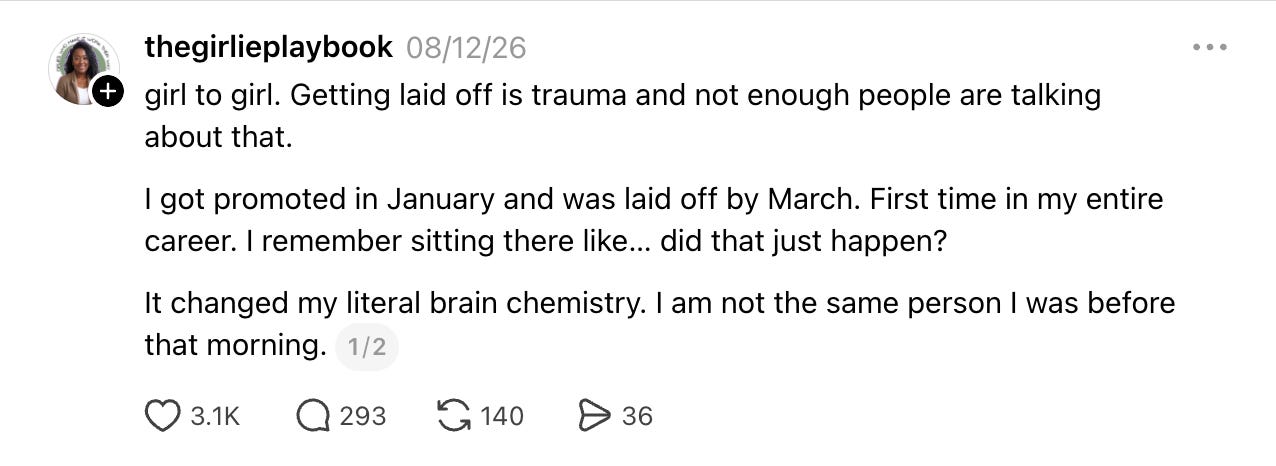
unprocessed trauma robs you of your agency. instead of making choices based on what you want for your future, your brain begins to dictate your life based entirely on what you fear from your past.
it changes your relationship with risk. your brain starts to misinterpret the unknown as inherently life-threatening, which can cause you to systematically avoid normal, healthy risks—passing up advancements or creative opportunities because staying small feels safer. or, if an opportunity feels too good to be true, you might subconsciously self-sabotage it, choosing chaos over peace because chaos is what you’ve been trained to expect.
it bleeds directly into your career choices, creating a layoff mindset. you might find yourself staying in a toxic or abusive job because you fear the unknown of a new company, or conversely, you might start quitting jobs at the first sign of minor tension just to leave before they can fire you. or you might swing the other way entirely, throwing yourself into unsustainable workloads and burning out, driven by a desperate, underlying belief that you are only safe if you are constantly producing.
it distorts how you handle your security and your money. it can trap you in a state of hyper-scarcity, causing you to obsessively hoard resources and deny yourself basic comforts or even medical care out of a terrifying feeling that total ruin is always just around the corner. or, it might push you toward impulsive, high-risk financial choices as a desperate way to self-soothe and regain a fleeting sense of control.
worst of all, it bleeds into your relationships and your boundaries. to avoid conflict or abandonment—which your brain now associates with danger—you might start people-pleasing, tolerating mistreatment, and saying yes to toxic demands because saying no triggers intense survival anxiety. or you might do the opposite, cutting people off and completely severing ties at the first sign of a normal disagreement, choosing to hurt others first before they can hurt you.

this is what is at stake. this is what that one act yesterday just triggered and initiated. while the machine may have taken your job yesterday, if you’re intentional, you don’t have to let it take your worth, your future or your power.
what you should do right now.
first, you sit with it. i know every survival instinct inside you is screaming at you to open LinkedIn, fix your resume, and start blasting out applications. your brain wants to fix the danger immediately. but i am asking you to just slow down for a second. sit in the quiet. let yourself be mad, let yourself grieve, and let the shock move through you. if you try to build a future today, you will build it out of fear. give yourself at least a few days where your only job is to simply exist.

second, you need to care for yourself like someone who has actually been through a traumatic event. because you have. this isn’t just unemployment—it’s a sudden, violent disruption to your safety. treat your body with immense gentleness right now. sleep when you are tired. drink water. step away from screens. do not treat yourself like a broken worker who needs to be optimized back into the labor market. treat yourself like a human being who just survived a crash.
and finally, remember that while the company and the culture of work is physically incapable of telling the truth, you can. you don’t have to carry their script anymore. you don’t have to pretend anymore, or that this is a blessing in disguise. when people ask you how you are doing or what’s next, give yourself permission to say the truest, most liberating words in the human language: i don’t know.
saying i don’t know is how you break the illusion. it’s how you tell the system that you refuse to perform certainty for them anymore and create room for something better flow in.
you don’t know what’s next, and that is completely okay. the future will come, and you will prosper. but for right now, know that you are loved, you are not alone and you will be ok.
sending u so much love,
m
p.s. we love and recommend our Substack friend, Melanie Ehrenkranz’s newsletter Laid Off. she’s built this cool space that demystifies the whole layoff culture by profiling all of the cool and wonderful people (like you) who get laid off every day.